The Woodwork Bench / Field notes & guides
Best wood for beginners: choosing affordable, workable timber
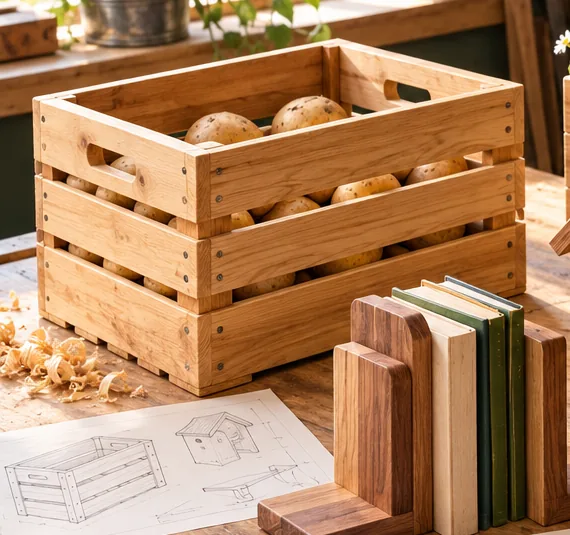
The best beginner timber is usually the one you can buy straight, dry and in a dimension that suits your project.
Softwood versus hardwood
Pine and other commonly sold softwoods are relatively easy to cut and drill and are often cheaper than decorative hardwoods. They can dent readily and sometimes contain knots or resin. Hardwoods can offer a tougher wearing surface but vary widely in price and workability. Do not treat either category as uniformly better: a clear, straight softwood board may be more suitable for a first shelf than a twisted hardwood offcut.
Inspect boards in the shop
Sight down the long edge for bow and crook, then look across the face for cupping and twisting. Avoid major splits, loose knots and visibly wet or damaged timber. Check both faces. Small defects may be acceptable if you can cut around them, but beginners often save more time by buying straighter boards than by trying to flatten difficult stock with limited tools.
Understand actual dimensions
Plan dimensions must be checked against the actual stock. A board sold under a nominal name may have been planed to a smaller finished size. If your plan assumes a 20 mm shelf and the shop carries 18 mm material, the assembly may still work—but dado widths, screw lengths and some external dimensions could need revision. Make those changes on paper before cutting.
Sheet materials and edges
Plywood is useful for boxes, cabinets and panels because it is available in broad, relatively stable sheets. Its quality varies; look at the core, face veneer and edge voids. MDF offers a smooth paintable face but produces fine dust and needs appropriate extraction and respiratory protection. Check whether your chosen screws and joints suit the material.
Match timber to the environment
An indoor decorative shelf has different requirements from an outdoor planter. Exterior projects need suitable timber, detailing that sheds water, compatible fixings and an appropriate finish. For load-bearing or safety-critical construction, do not substitute materials without checking the design. For an ordinary beginner project, start with sound, dry stock and a clear plan.
A buying checklist at the timber rack
Read the plan before visiting the merchant. Record finished thickness, width, length and whether the parts must be suitable for indoor or outdoor use. At the rack, measure the actual thickness and inspect each board for straightness. A board with an attractive grain pattern may still be a poor choice if it is twisted.
Ask whether the stock is rough-sawn, planed or pressure-treated. Those descriptions affect dimensions, handling and finishing. Treated timber may require specific fasteners and handling precautions. Never burn treated offcuts, and follow the supplier’s guidance for cutting and disposal.
How defects change the cutting plan
Suppose you need four 400 mm rails. A single 1.8 m board appears long enough on paper, but the saw removes material at each cut, and a knot or split may force you to discard a section. Sketch where each part could come from, allowing for blade kerf and a small end trim. If the clear sections do not fit, buy another board rather than placing a defect in a highly stressed location.
Grain direction matters as well. Solid wood expands and contracts mainly across the grain as humidity changes. Wide solid panels need a construction method that accommodates that movement; do not copy a rigid plywood fixing detail into a solid-wood tabletop without checking the design.
When to choose plywood instead
A broad shelf or cabinet side can often be cut efficiently from plywood, especially when the plan is designed around sheet stock. Check the grade, thickness and edge quality. A nominal 18 mm sheet may differ slightly from another manufacturer’s sheet; test-fitting a dado or groove to the actual sheet is more reliable than assuming every sheet is identical.
Related practical guides
Read and check a woodworking plan · Make a shopping list · See a worked shelf example · Use the wood calculator