Practical planning guide
How to choose woodworking plans you can actually use
Compare free and paid woodworking plans by completeness, buildability, tool requirements and seller terms.
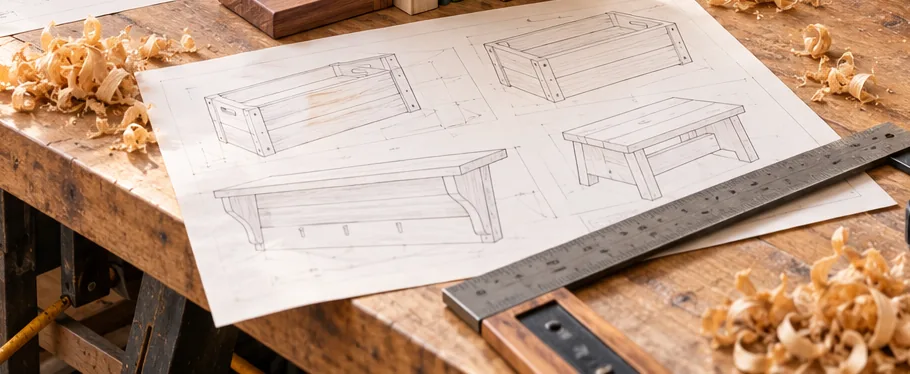
Look beyond the cover picture
A finished-project image cannot tell you whether the plan includes all the dimensions. Look for front, side and top views, a component list and a clear assembly sequence. The 12-point checklist is designed to help you identify omissions.
Match the plan to your workshop
Underline each operation and tool requirement. If the plan assumes a thickness planer, router table or lathe you do not have, decide whether a safe alternative exists before purchasing material. A design is not beginner-friendly merely because its title says it is.
Check whether the cut list reconciles
Add the widths of adjacent parts and compare them with the stated overall size. Check whether a shelf fits between or on top of its sides. Inconsistent dimensions are a reason to seek clarification or choose a different plan.
Read the seller’s current terms
For a paid collection, check exactly what is delivered, the current price, the refund policy and the seller’s support contact. Do not assume an advertised number of plans guarantees their individual completeness. Our Ted’s offer analysis explains what is and is not independently verified.
Use a free sample as a quality test
Before paying, examine a sample for readable diagrams, material specifications and steps that can be followed without guessing. If the sample does not answer your basic questions, a larger collection may not solve that problem. Free plans should still be assessed critically.
Compare two plans for the same object
Imagine two small-shelf plans. One gives only a finished photograph and an overall width. The other provides front and side views, a part-by-part cut list, hardware sizes and a sequence that explains the joints. The second is easier to check before buying timber. That does not prove the design is structurally sound, but it gives the reader enough information to identify missing details and ask better questions.
What a free sample can and cannot establish
A free sample can reveal how the seller formats drawings and explains common operations. It cannot demonstrate the quality of every design in a large library. Look for the exact type of project you intend to build, then inspect the specific drawing and hardware requirements. Do not assume that a large advertised plan count means every plan is complete, up to date or suited to your tools.