The Woodwork Bench / Field notes & guides
Circular saw vs table saw: which suits your projects?
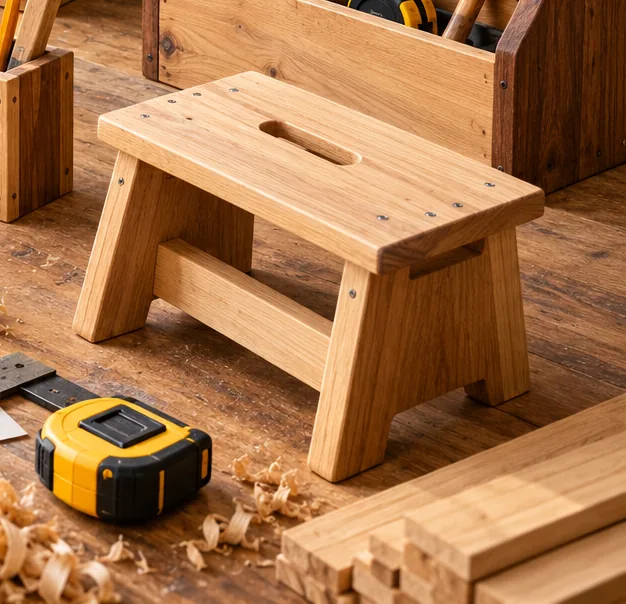
These saws overlap, but their workholding and cutting workflows are different.
How the work moves
With a circular saw, the tool travels across a supported workpiece. With a table saw, the workpiece travels past a stationary blade. That distinction matters for long sheet cuts, repeatability and workshop space. A circular saw with a properly secured straightedge is a practical choice for breaking down plywood. A table saw can be efficient for repeated narrow strips when correctly set up.
Accuracy comes from setup
Neither tool is automatically accurate. A circular saw cut depends on a straight guide, stable support and accounting for the blade-to-base offset. A table saw cut depends on fence alignment, a suitable blade and controlled feeding. Check measurements with a test cut before cutting every component of a project.
Safety differences
Both tools can kick back. Follow the manufacturer’s instructions, use the required guards and appropriate eye and hearing protection, and keep the cutting path clear. On a table saw, use a riving knife and suitable push devices as specified by the manufacturer. Never reach across a running blade. With a circular saw, support the offcut so it cannot pinch the blade, and avoid cutting where the blade can contact a bench or hidden fixing.
Which projects favour each?
If you mostly build occasional shelves, boxes and sheet-material projects in a small space, a guided circular saw may meet your needs. If you repeatedly rip solid timber to matching widths and have the room and training for it, a table saw may offer workflow advantages. Many makers use both, but there is no requirement to buy both at the start.
Before buying
List your next three projects and their longest, widest and narrowest cuts. Check that the tool can perform those operations safely. Budget for a stable work surface, guides, extraction and protective equipment rather than comparing the saw prices alone.
Example: cutting a sheet into shelf panels
A full sheet can be awkward to control on a table saw without suitable infeed and outfeed support. A circular saw guided along a straightedge can divide a well-supported sheet into smaller pieces. Plan the cut line so the blade cannot strike the support, and make sure both the retained piece and offcut behave predictably.
Once the sheet is in manageable sections, a table saw may help produce repeatable widths if the machine, fence and workholding are appropriate. That does not mean every narrow cut is safe on a table saw. Consult the saw manual for minimum stock dimensions, push devices and any restrictions on the operation.
Make a fair comparison of total cost
Compare more than the saw itself. A circular saw setup may need a guide, clamps and a sacrificial cutting surface. A table saw setup may need a stand, outfeed support, dust extraction and storage space. Both need suitable blades and personal protective equipment.
If the workshop is a shared garage, the ability to store a circular saw safely may be more valuable than the speed of repeated ripping. If you are producing dozens of identical strips, repeatability may matter more. Choose based on actual work and safe working conditions.
Avoid misleading precision claims
A factory scale is a starting reference, not proof that a cut is correct. Check the fence or guide against a test piece, measure the finished cut and account for kerf. If the blade is changed, the cut width and behaviour may change too. Always follow the equipment instructions rather than a generic setup recipe.
Related practical guides
Read and check a woodworking plan · Make a shopping list · See a worked shelf example · Use the wood calculator