The Woodwork Bench / Field notes & guides
How to estimate the real cost of a woodworking project
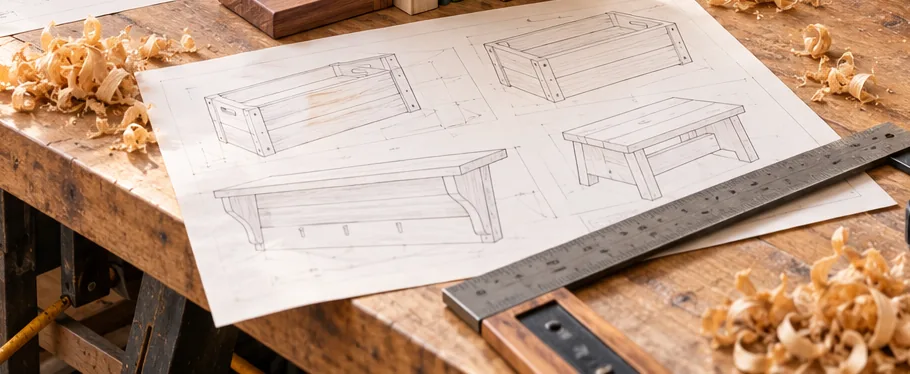
The timber bill is only one part of a useful project budget.
Start with a cut list
For each part, record material, finished dimensions and quantity. Group parts that can come from the same board or sheet. Draw a rough cutting layout and account for saw kerf, end trimming and defects. Buying exactly the summed finished lengths is rarely enough.
Price the stock you can buy
A plan may call for 2.3 metres of timber, but the merchant may only sell 2.4-metre lengths. Work out the number of actual boards or sheets required, then multiply by the local price. For sheet material, check whether transport or cutting services cost extra.
Add the overlooked items
Include screws, glue, brackets, hinges, abrasives, finish, disposable brushes and protective equipment. If the plan calls for a specialist cutter or jig you do not own, either include its cost or select a different design. Delivery and waste-disposal costs can also matter.
A worked example
Suppose a small shelf needs two boards at £9 each, a pack of screws at £4, brackets at £8 and finish at £7. The cash outlay is £37 before delivery, even if you use only part of the screw pack and finish. If you already own those consumables, the incremental cost may be lower. Distinguish total checkout cost from the portion consumed by one build.
Keep a contingency
A small allowance for a miscut or damaged board is prudent, especially on your first attempt. After the build, compare estimated and actual spend. That record makes your next estimate more reliable than relying on a generic cost-per-project figure.
Distinguish the checkout bill from material used
A pack of fifty screws may cost £5 even when a project uses eight. Your first build pays the full checkout price; later builds may use the leftovers. Keep two columns if you want a realistic comparison: cash you must spend now and the estimated share consumed by the project.
Likewise, buying a 2.4 m board for a 1.6 m requirement creates an offcut. It is only a saving on the next project if that offcut is long enough, sound enough and of the right material. Do not subtract its imagined resale value from the first project’s budget.
Calculate waste with a cutting layout
Suppose a plan requires two 700 mm rails and two 350 mm blocks. Their combined finished length is 2,100 mm. A 2.1 m board is not sufficient once saw kerf and end trimming are included. A 2.4 m board might be, assuming the stock is sound and the cutting order fits.
For plywood, sketch rectangles to scale on the available sheet size. Allow for kerf, grain or face direction and the ability to support each cut. A cutting layout that fits mathematically may still be awkward or unsafe to execute with the equipment available.
Compare alternatives fairly
If a ready-made item costs less than the raw materials, the project may still be worthwhile for learning or custom dimensions. Conversely, a DIY project is not automatically cheaper when you include finish, hardware and tools. Decide whether your goal is saving money, learning a technique or making something unavailable off the shelf.
Related practical guides
Read and check a woodworking plan · Make a shopping list · See a worked shelf example · Use the wood calculator