The Woodwork Bench / Field notes & guides
Pocket-hole screws versus traditional woodworking joints
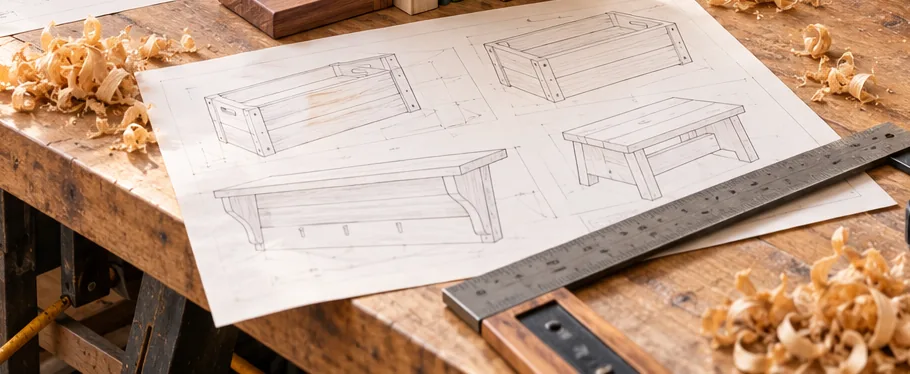
A joint should be chosen for the loads, appearance, material and assembly sequence—not for its reputation.
What pocket holes do
A pocket-hole jig drills an angled hole that allows a screw to pull two components together. The method is quick and can be useful for face frames, utility furniture and hidden connections. Correct screw type and length matter; an overlong screw can emerge through the face, while a short one may not engage enough material.
Where they are less suitable
Pocket holes may be visible on an exposed face and may not be the best choice for every structural or repeatedly stressed joint. They also depend on the material holding a screw reliably. Thin sheet goods and end-grain connections require special care. Test a joint on offcuts and consult the jig manufacturer’s guidance for material thickness and screw selection.
What traditional joints offer
Dados and rabbets help locate panels and provide glue surface. Mortise-and-tenon joints can be useful where a rail meets a leg. Dowels and loose tenons offer alignment and hidden joinery but require accurate layout or dedicated jigs. Traditional joints are not automatically superior: poor fit and inadequate glue application can weaken them.
A comparison for a simple shelf
For a small utility shelf, visible screws through a back rail may be straightforward. Pocket holes might hide fixings on the underside. A housed dado could locate the shelf more positively but requires additional cutting. Choose the method that the plan actually explains and that you can execute accurately.
The practical rule
Decide what the joint must resist, whether it will be seen, and how you will clamp it. If the project carries significant weight or creates a safety risk, rely on an appropriate proven design rather than swapping joints casually.
Consider the direction of the load
Imagine a rail joined to a cabinet side. The joint may be asked to resist pulling apart, twisting or sideways racking. Those are different demands. A joint that is convenient for positioning a face frame is not automatically appropriate for a heavily loaded seat or a suspended cabinet.
Before choosing joinery, sketch the force path: where does the weight enter, how does it pass through the parts, and where is it supported? If you cannot answer that, seek a proven plan with suitable joints rather than selecting the fastest-looking method.
Dry fit before committing
With pocket holes, clamp the parts in their intended alignment and check that the screw will not exit through a visible face. Use the jig maker’s chart for material thickness and compatible screws. Test on scrap from the same material because sheet goods and solid timber can behave differently.
For a dado, cut a test groove in an offcut and check the fit with the actual shelf stock. A tight fit that requires heavy hammering can damage the panel or prevent the assembly from seating squarely. A loose fit may fail to locate the shelf as intended.
Appearance and repairability
A hidden pocket hole may be desirable on a utility cabinet, while a visible through-screw may make later repair easier. A carefully made housed joint can conceal the fastening method but takes additional layout and machining. Decide whether appearance, speed or future disassembly matters most for the specific piece.
Related practical guides
Read and check a woodworking plan · Make a shopping list · See a worked shelf example · Use the wood calculator