The Woodwork Bench / Field notes & guides
Small workshop layout: plan a safe, workable space
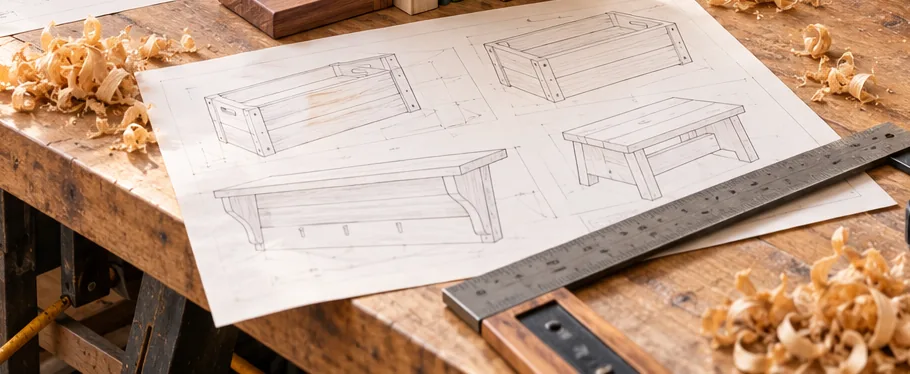
A compact workshop works best when the cutting and assembly paths are planned before equipment is purchased.
Map the full work envelope
Measure the room, then sketch doors, sockets, lighting and fixed obstacles. A machine’s footprint is not its working footprint: long boards need infeed and outfeed clearance. Mark the route you would use to carry a sheet into the room. If that route is blocked, plan to break down sheets elsewhere using a safe supported method.
Separate cutting from assembly
A clear bench is valuable for layout and glue-ups. If you use it as a cutting station, protect the surface and remove offcuts before assembly. Wall storage can free floor space, but heavy items need fixings suited to the wall and their load. Keep frequently used measuring tools within reach.
Control dust and noise
Match extraction to the tool and material, and clean with a suitable vacuum rather than blowing fine dust into the air. Dust from MDF and some hardwoods requires particular attention. Follow local guidance and the tool manufacturer’s requirements for respiratory, eye and hearing protection.
Plan electrical access
Avoid trailing leads across walkways. Check the electrical capacity and condition of the installation; seek a qualified electrician where appropriate. Good task lighting makes layout lines and blade positions easier to see. Keep finishes and flammable materials away from heat and ignition sources.
Design for the projects you actually build
A folding work surface may be better than a permanent oversized bench if the room doubles as storage. Make a mock layout with cardboard or tape before buying machinery. Leave space to retreat from a cut and to set down a workpiece without balancing it precariously.
Try a floor-plan exercise
Draw the room as a rectangle and add door swings, windows, sockets and any areas that must stay clear. Use paper rectangles for the bench, tool storage and equipment. Move the pieces around before spending money. The most important test is whether a workpiece can enter, be cut and leave without colliding with a wall or another person.
A machine that fits in the corner may still be unusable if a long board cannot pass through it. Measure the actual workpiece sizes from your planned projects, not just the tool dimensions in a catalogue.
Give each activity a home
A bench needs enough clear area for marking and assembly. A cutting station needs predictable support for the work and offcut. Finishing needs ventilation appropriate to the product, space to let pieces dry and safe storage for materials. Combining these functions in one room is possible, but the bench may need to be cleared between operations.
Store heavy items where they cannot fall, and keep sharp tools protected. Do not position a charging station next to combustible finishing supplies. Follow battery and charger instructions and keep access to exits unobstructed.
Plan for the people around you
Noise and airborne dust can affect others in a shared home or garage. Choose suitable working hours, use extraction and clean up thoroughly. Check the tool and material guidance for protective equipment and ventilation; opening a door alone is not necessarily adequate control for fine dust.
Related practical guides
Read and check a woodworking plan · Make a shopping list · See a worked shelf example · Use the wood calculator