Independent woodworking planning guide
Woodworking plans in inches: a conversion guide
US readers often shop in inches and feet, while a downloadable plan may use millimetres. Converting the numbers is only the first step.
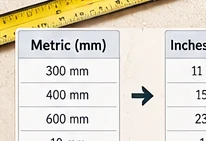
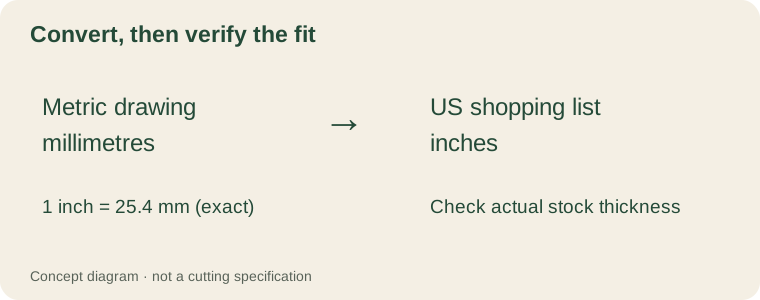
Use exact conversion factors
One inch equals exactly 25.4 mm. To convert mm to inches, divide by 25.4. For example, 300 mm is about 11.811 inches—not automatically a convenient 11¾-inch cut.
Do not round every component independently
If a box uses two 12 mm side walls, converting each to a rounded fraction and separately rounding the outside width can create a mismatch. Choose the actual stock first, then recalculate the mating parts from the intended overall size.
Nominal and actual timber
A US nominal 1×4 is commonly sold at an actual ¾ × 3½ inches; verify the specific product. Plywood thickness can also differ from its label. Never substitute a nominal label for a measured dimension in a joint.
Mark units on every drawing
Put “in” or “mm” in the title block and beside ambiguous dimensions. Avoid mixing 12 mm plywood with a ½-inch dado without checking fit. Make a test joint in scrap before cutting all panels.
Use one master dimension
For a box, decide whether the critical dimension is inside clearance or outside width. Convert that target once, choose actual stock, then calculate dependent pieces. See our measurement guide for examples.
Convert a dimension without rounding it away
A 300 mm part is approximately 11.811 inches, not exactly 12 inches. Rounding it to 12 inches changes the part by about 4.8 mm. If several parts stack together, these changes can accumulate. Keep one authoritative dimension system for the whole project, and convert only when needed for purchasing or marking.
US nominal lumber labels also differ from actual dressed dimensions. Do not replace an 18 mm panel with a nominal 3/4-inch board without checking its measured thickness; the joint and inside-clearance calculations may change. For a close-fitting assembly, measure your real stock and revise the drawing before producing the final cut list.