Independent woodworking planning guide
DIY planter box plans: a practical planning guide
A planter box needs more than four sides: drainage, wet soil, timber movement and its final location affect the design.
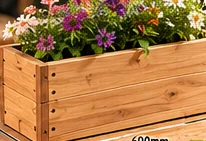
Decide whether it is a sleeve or a soil-holding planter
A decorative sleeve can hide a removable plastic container. A soil-holding box needs a drainage route, a base that can support wet soil and details that allow the timber to dry. Our indoor plant-pot sleeve is the simpler beginner example.
Measure the actual container
For a sleeve, measure the widest point of the plastic pot and its saucer, then allow clearance for lifting them out. For a soil-holding box, decide the inside planting volume first; outside dimensions depend on board thickness.
Build a cut list that reconciles
If front and back panels run the full outside width W and side panels fit between them, each side panel is outside depth D minus twice the actual panel thickness t: D − 2t. If the sides overlap instead, that equation changes. Sketch the corners before buying stock.
Keep water moving
A watertight decorative box can trap water. Use a removable tray for an indoor sleeve; for an outdoor soil-holding planter, plan drainage openings, a suitable liner or separator where appropriate, and clearance beneath the base. Do not block drainage with a finish.
Finish and placement
Choose an exterior-rated finish suitable for the intended use and follow its instructions. Soil-contact and edible-crop applications warrant particular care over product suitability. Do not assume a decorative planter can safely be suspended from a railing.
Work through the inside dimensions
Imagine a rectangular planter with a 600 mm outside length, two 18 mm end panels fitted between the long sides, and a separate base. The internal length is 600 − 2 × 18 = 564 mm, provided the construction actually places those end panels inside the stated outside length. If the ends overlap the sides instead, the calculation changes. Write down which faces overlap before producing a cut list.
Decide whether the planter will hold a removable pot or soil directly. A removable pot needs enough clearance for lifting it out; a soil-filled box needs a considered drainage route and suitable lining that does not trap water against the wood. Check the loaded weight and supporting surface. This is a sizing example, not a tested outdoor planter design.